
You would rather see a change before your customers do.
Nothing goes live on its own
Everything an agent writes stays a draft. It reaches the public only when a person publishes it.
Whether you coded your app yourself or built it with an AI coding tool, Garchi keeps its pages, posts, product data, images and translations in a hosted CMS. Your app reads them over an API. You and your team edit them in a dashboard, or ask your AI to, and nothing goes live until you publish.
No CMS to host. No admin panel to build. No redeploy for a copy change.
Free Sandbox plan · no card required
Copy, prices, images and posts change every week, long after the code is done.
Today each of those means a code change and a redeploy, or re-prompting your coding agent and checking what else it touched. In Garchi it's a quick edit in the dashboard, or one sentence to your AI.
How it works
Your components say what they need, whether you wrote them or your AI did. The same fields show up in Garchi, where you, your team or your AI agent fills them in.
type Props = { step_number?: string; title?: string; description?: string; icon?: string; [x: string]: any;}; export default function StepItem({ step_number, title, description, icon, ...props}: Props) { return ( … );}It declares the fields it needs. Nothing else.

Those same fields, filled in, with the page updating beside them.
step_number
title
description
icon
Your framework, your hosting and the code you or your AI wrote stay as they are. Garchi sits behind them and replaces none of it.
Text, images and product data leave the repo and live in Garchi, so changing them never touches the code.
Update a headline, fix a price or publish an article from the dashboard, or ask your AI to. No pull request and no deploy.
All three work on the same content. Use the dashboard, the API or MCP depending on the task.
Connect Claude, ChatGPT, Claude Code or Cursor and it works on your real content: drafting pages, writing posts, updating products, reordering sections and using the images already in your space. Setup is a URL and one approval.
MCP is the open standard these AI tools use to connect to other software. Garchi's MCP server is built in, so you have nothing to code. Everything the agent writes waits as a draft until you publish it.
YOUR AI AGENT
The agent reads your content model and calls the same operations your team uses in the dashboard.
Drafts and undo
Let an AI edit your live site directly and one bad sentence reaches your customers. In Garchi its changes stay drafts until you publish them, and you can roll any of them back.
You would rather see a change before your customers do.
Everything an agent writes stays a draft. It reaches the public only when a person publishes it.

You notice it days later, and nobody remembers what it said before.
Every change leaves a restore point for 30 days, labelled with who made it. Rolling back takes a click.

Reading a diff doesn't tell you whether the page actually looks right.
Drafts render on your own frontend, visible to you and nobody else, until you are happy with it.
Fixing one word means a pull request and a deploy.
Content lives outside your codebase. Whoever changes it, you ship code only when the code changes.
What's included
A dashboard for editing, an API for your app and a connection for your AI tools. We host and maintain all of it, so you can get back to your product.
Pages built from reusable sections, articles, products, categories, images and translations. Whoever owns the content can edit it, with no application code involved.
Your application stays yours. Garchi serves its content over REST, with Node.js and PHP SDKs and starter kits for Next.js, Nuxt and Laravel.
Claude, ChatGPT, Claude Code and Cursor reach the same content through Garchi's built-in MCP server. You have no agent integration to build or keep running.
No CMS server to run and no content infrastructure to maintain. Each project gets its own space, with its own content and collaborators.
Starter kits
Starting a new project? Run one command yourself or hand it to your coding agent. Kits for Next.js, Nuxt and Laravel. For SvelteKit or any other stack, use the Node.js SDK or call the REST API.
npx @lumenharbor/garchi-starter-kit -k next
Content modelling
Your blog post has authors. Your product page has pricing tiers. Your case study has industry tags. Garchi's data items start with a base schema, and you add the metadata your content needs without touching your app's database.
Publishing
Need something on LinkedIn, Instagram or Facebook? Draft it in Garchi, get it approved, then publish or schedule it from the same place as the rest of your content.
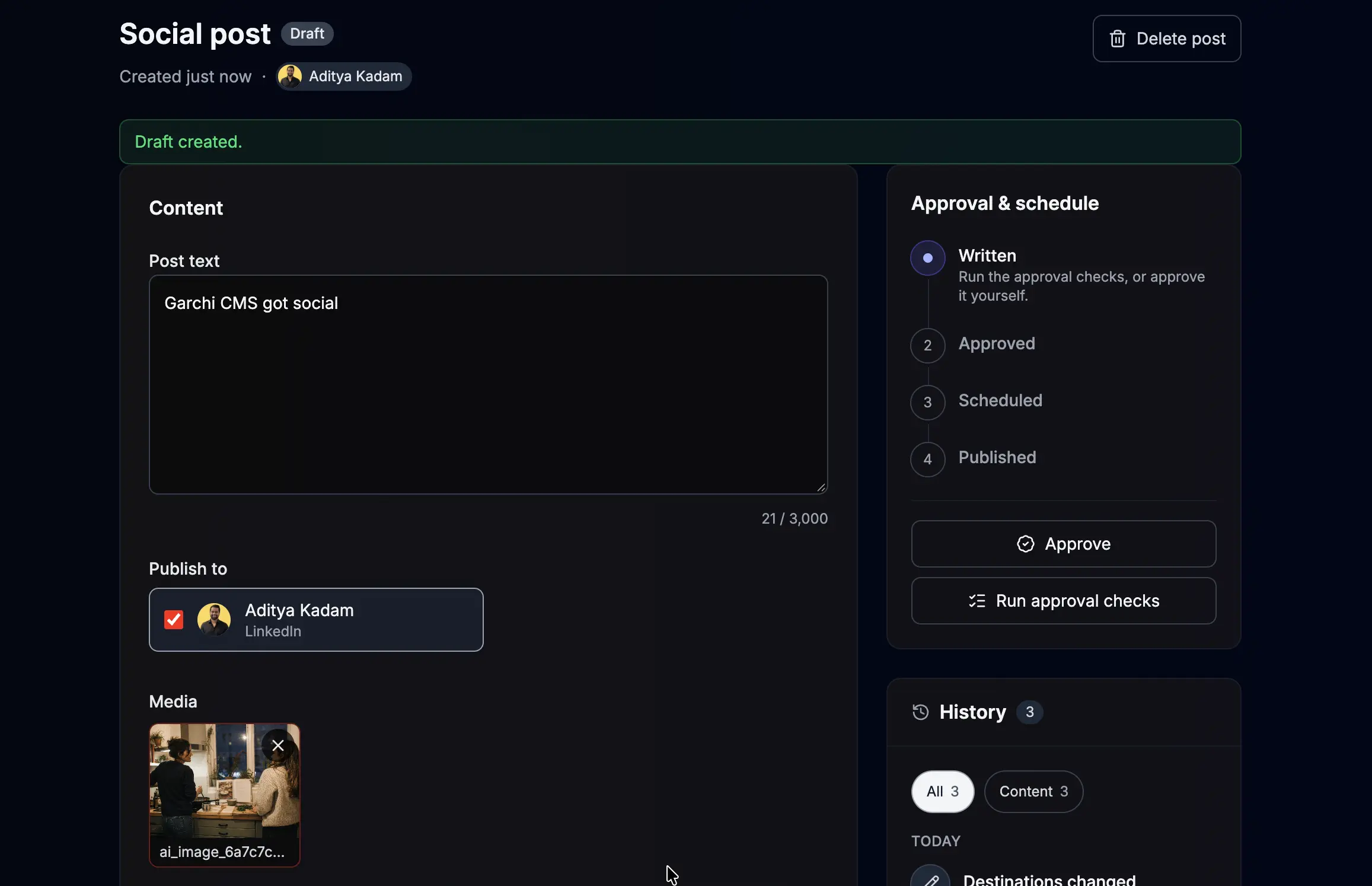
Draft
Write it, or let an agent draft it from content you already have.
Approve
Someone reads it and signs it off.
Schedule
Send now or set a time. Editing an approved post reopens the approval.
Publish
Garchi posts to each channel and records what happened on each one.
Your AI can draft a post and send it for approval. Approving, scheduling and publishing stay with you and your team.
Images and video both work. Every plan includes a number of publishes, and every post keeps a record of what was sent and what each channel did with it.
Already use a dedicated social platform? Keep it. Garchi handles straightforward publishing from your content workflow, and your existing tools carry on with engagement, analytics, listening and broader campaign management.
Built for
Whichever sounds like you, you start on the same free plan.
Building with AI
You prompted the frontend into existence. Now every wording change means prompting again and hoping nothing else moves. Put the content in Garchi, and the same AI can still edit it through MCP.
Product teams and developers
Give marketing and content people somewhere to manage landing pages, articles and product copy. Developers keep the architecture and ship code only when the code changes.
Agencies and client projects
Build the site, then hand the client somewhere to manage it. Paid plans include several spaces, each with its own content and collaborators, so clients never see each other's work.
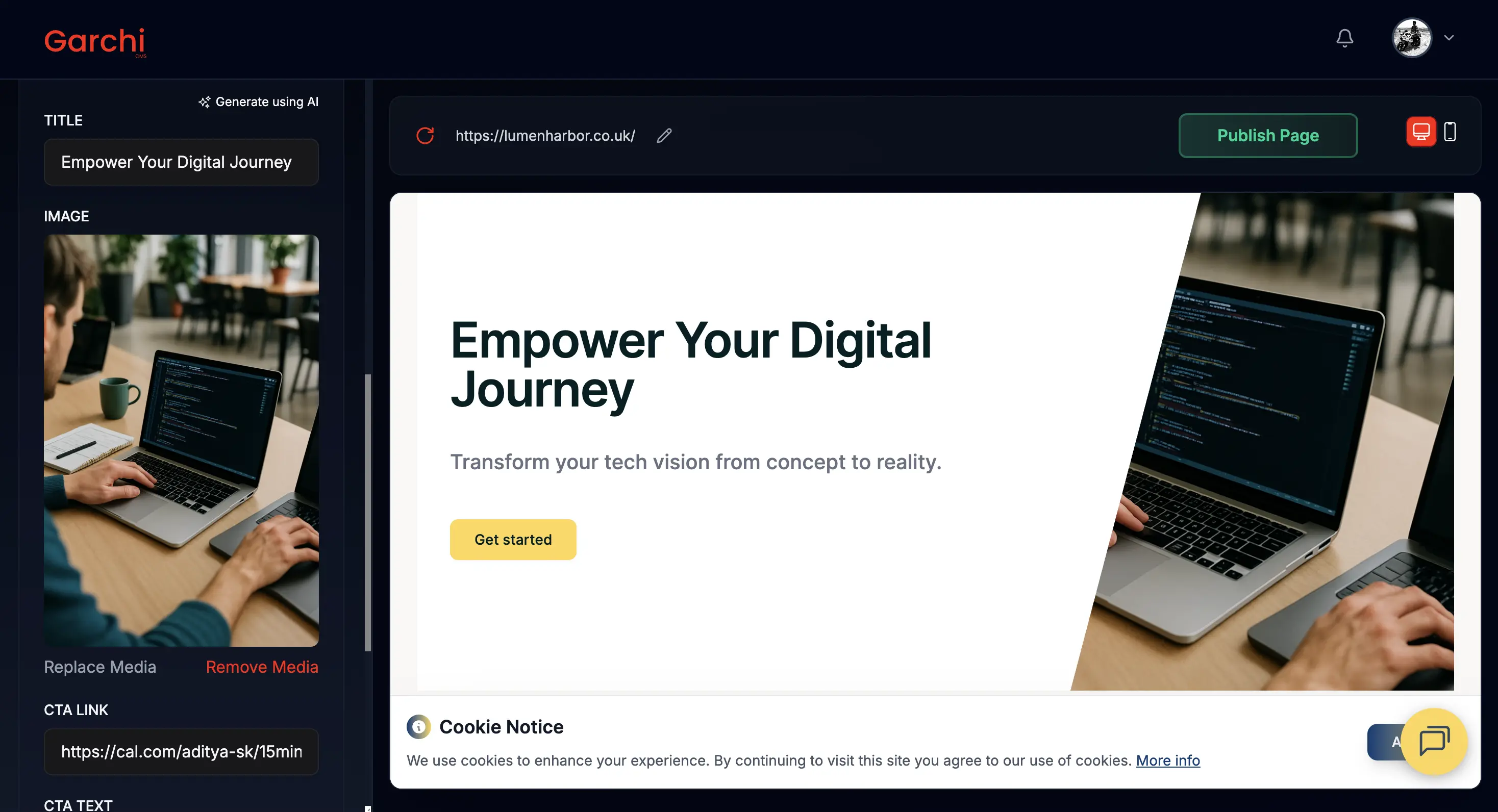
Product tour
Sign up, connect your AI tool and ask it to build your first page in Garchi. Sandbox is free, and the dashboard works just as well if you'd rather click.
Free Sandbox plan · no card required